
Insights from a Practicing Veterinarian
After over a decade as a small-animal veterinarian, I’ve learned many cat owners misread submissive behavior. A cat crouching, flattening its ears, or rolling to its side can seem dramatic to those unfamiliar with feline body language. Owners may assume the cat is ill, afraid, or “being dramatic.” Usually, it’s just communication.
Cats rely heavily on subtle body signals to avoid conflict. Submissive behavior is one of their primary tools for keeping peace, especially in multi-cat homes or when dealing with unfamiliar people or animals.
What Submissive Behavior Looks Like in Cats
Submissive signals in cats are quieter and more nuanced than many people expect. Unlike dogs, cats rarely display exaggerated gestures to show submission. Instead, they rely on posture and small movements.
In my exam room, I frequently see cats lower their bodies close to the table while slightly tucking their tails. Their ears angle to the side or back, and their pupils widen. Some will avoid eye contact completely.
Another common signal is the partial side roll. Many owners interpret this as an invitation to rub the cat’s belly. Sometimes it is, but often it’s simply the cat saying, “I’m not a threat.” Touching the belly in that moment can result in a quick swat, which surprises the owner but makes perfect sense from the cat’s perspective. The key distinction is that a true invitation to petting is usually accompanied by a loose, relaxed body, while cautious submission is often marked by tense muscles and wary movements.
Submissive behavior also includes:
- Slow blinking
- Turning the head away
- Grooming suddenly during tense moments
- Remaining still or freezing when approached
These behaviors help a cat de-escalate a situation without physical confrontation.
A Case That Changed How One Owner Saw Her Cat
A client once brought in a young rescue cat that she believed had been abused. The cat flattened herself against the floor whenever the owner walked into the room. The owner was heartbroken and convinced the cat feared her.
During the exam, I noticed something interesting. When the owner sat quietly and avoided direct eye contact, the cat slowly approached her, tail low but relaxed. After a few minutes, the cat began rubbing against the owner’s leg. What appeared to be fear was, in fact, cautious submission. The cat’s signals reflected uncertainty, not trauma. I explained that direct staring and rapid movements can intimidate a cat adjusting to a new environment.
A few weeks later, the owner stopped by the clinic to tell me the cat now followed her everywhere. Nothing about the cat’s personality had changed; the owner simply learned how to read the signals.
Submissive Behavior in Multi-Cat Homes
Some of the most obvious submissive displays appear in homes with multiple cats. I see this dynamic often during behavior consultations.
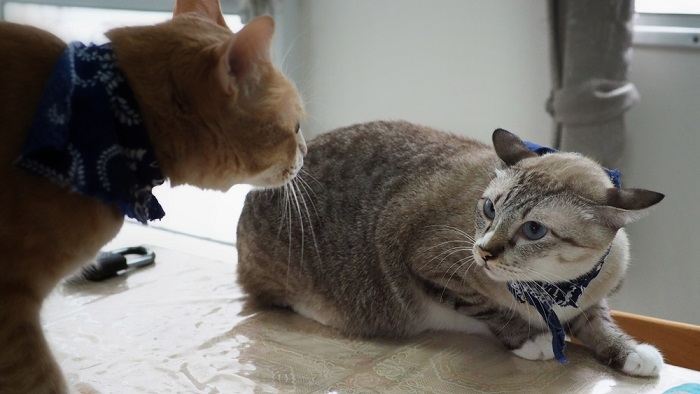
One household I worked with had two adult cats that seemed to “bully” each other around the food bowls. The smaller cat frequently crouched, avoided eye contact, and let the other eat first. The owners assumed the dominant cat was aggressive.
After observing their interactions, it became clear that the submissive cat was simply more conflict-averse. She preferred yielding rather than competing.
This is a normal feline social structure. Unlike dogs, cats don’t operate with rigid dominance hierarchies, but they do develop routines that prevent conflict. Submissive behavior is often the mechanism that keeps the peace.
In that case, I suggested adding a second feeding area in another room. The tension disappeared almost immediately.
The Mistake Many Owners Make
One of the most common mistakes I see involves misinterpreting submissive signals as affection. The belly exposure example is the classic one.
I remember examining a young cat that had scratched her owner several times over the course of one week. The owner insisted the cat was “inviting belly rubs” because she rolled onto her back whenever approached.
During the visit, the cat did the same thing on the exam table. Her ears were slightly back, tail tip twitching, and her body was tense. That wasn’t relaxation. It was a defensive submission — a cat preparing to protect itself if necessary.
Cats can expose their belly for two completely different reasons:
- Relaxed trust
- Defensive submission
The body tension tells the real story. A loose body means comfort. A stiff body means caution.
Stress Can Intensify Submissive Signals
Cats under stress often exaggerate submissive behavior. Veterinary clinics are a perfect example. Many cats in exam rooms crouch low, bodies compressed and eyes wide, which some owners interpret as “shutting down.” In reality, the cat is trying to look non-threatening.
I once treated a large orange cat that froze completely on the exam table. He looked terrified. The moment I gave him space and lowered my voice, he slowly relaxed and even began kneading the towel beneath him. That shift occurs often. A cat displaying submission is usually trying to de-escalate rather than preparing for aggression.
Reading the Whole Cat, Not Just One Signal
Understanding feline behavior means seeing the whole picture, not just one movement. Body posture, tail, ears, and eye shape all matter.
Over the years, I’ve found that owners who learn to read these signals tend to have calmer relationships with their cats. They know when the cat wants space and when it’s actually inviting contact. Submissive behavior often reflects a cat’s effort to maintain harmony. It’s a subtle language that seeks to prevent conflict rather than draw attention.
Cats rarely communicate loudly unless they feel misunderstood. When someone recognizes those small gestures — the head turn, the slow blink, the lowered posture — the entire relationship between cat and human becomes easier.
From my perspective in the clinic, most “behavior problems” involving cats begin with misread signals. Submissive behavior is one of the clearest examples. Once people understand what their cat is actually saying, the confusion tends to disappear.