
Insights from the Vet’s Room
As a licensed veterinarian practicing in Texas for over a decade, I’ve had more uncomfortable conversations about cat mating behavior than I can count. Owners whisper. They laugh nervously. Some are convinced their cat is in pain. Others are certain that something is “wrong” because the behavior looks dramatic, loud, and sometimes even aggressive.
In most cases, what they’re seeing is completely normal feline reproductive behavior. But normal doesn’t always mean harmless — especially in a domestic setting.
Let me walk you through what I’ve seen firsthand in exam rooms, living rooms, and occasionally in frantic after-hours phone calls.
The Female in Heat: Loud, Restless, and Misunderstood
The first time many owners encounter a female cat in heat, they assume she’s injured.
I remember a client who rushed her young indoor cat to my clinic late one spring afternoon. The cat had been yowling for two nights straight, rolling on the floor, sticking her hindquarters in the air, and treading her back paws like she was marching in place. The owner was convinced her cat had abdominal pain.
She wasn’t in pain. She was in estrus.
A female cat in heat will:
- Vocalize loudly, often in drawn-out, almost mournful cries
- Become unusually affectionate or clingy.
- Roll, rub, and press her body against furniture and people.
- Raise her hindquarters when touched along her back.
- Attempt to escape outdoors.
That last one is the one that gets people in trouble.
In my experience, even strictly indoor cats become astonishingly determined escape artists during heat cycles. I’ve seen cats tear through window screens and bolt between legs at the front door. Hormones override training every time.
The Male’s Behavior: Driven and Persistent
Unneutered male cats are equally predictable — and equally misunderstood.
A few summers ago, a client brought in her intact male because he had started spraying urine throughout the house and fighting with neighborhood cats. She thought it was behavioral defiance.
It wasn’t.
An intact male cat’s brain is wired to detect a female in heat from surprising distances. Once that happens, you’ll often see:
- Urine marking has a strong, pungent odor.
- Restlessness and pacing
- Attempts to escape
- Increased aggression toward other males
- Loud yowling, especially at night
The odor difference between neutered and intact male urine is something you never forget once you’ve smelled both. There’s a musky sharpness to intact male spray that’s hormonally driven. Cleaning products rarely solve the problem completely because the behavior isn’t about cleanliness — it’s about territory and reproduction.
The Mating Act Itself: Why It Looks So Violent
One of the most alarming things owners witness is the mating process itself.
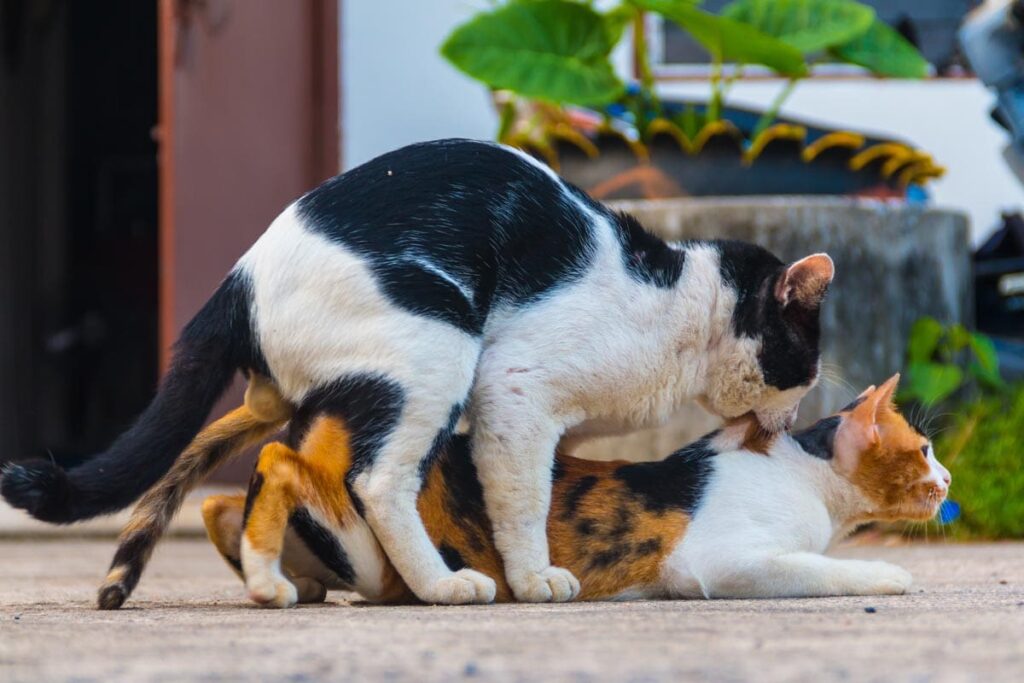
Cats are induced ovulators. That means the act of mating itself triggers ovulation in the female. The male’s penis has small keratinized spines that stimulate the female’s reproductive tract. That stimulation is necessary biologically, but it makes the process appear rough.
During mating:
- The male grips the female’s neck.
- The act is brief — often only seconds.
- The female will typically scream or yowl.
- Afterward, she may swat or chase the male.
I once had a client call in a panic because her two intact cats had mated and the female “attacked” the male immediately afterward. She assumed something had gone wrong.
It hadn’t.
That post-mating aggression is common. The stimulation causes a sharp sensation, and the female reacts instinctively. Within minutes, she often rolls on the floor, and the cycle may repeat multiple times over several hours.
It’s biological efficiency — not relationship drama.
Common Mistakes I See Repeatedly
Over the years, I’ve noticed a few patterns in how owners handle mating behavior.
The first mistake is assuming the behavior will stop on its own. Heat cycles repeat every two to three weeks during the breeding season if the female does not become pregnant. That means the vocalizations and escape attempts keep recurring.
The second mistake is separating intact male and female cats too late. I’ve had more than one owner say, “They’re siblings, so they won’t mate.” They absolutely will. Cats do not have the same social barriers humans do.
The third mistake is delaying spaying or neutering because the owner wants the cat to “experience one heat” or “have one litter.” Medically speaking, there is no behavioral or emotional benefit to allowing a female cat to go through heat or pregnancy before spaying. In fact, early spaying significantly reduces the risk of mammary tumors later in life.
I’m not neutral on this topic. Unless someone is an experienced, responsible breeder with a clear plan and veterinary oversight, I strongly recommend spaying and neutering.
Behavioral Changes After Mating or Pregnancy
After successful mating, some behavioral shifts occur quickly.
A pregnant queen often becomes calmer within days of ovulation. The frantic calling stops. Appetite increases. She may become more selective about where she rests.
I recall a rescue volunteer who fostered a stray that turned out to be pregnant. Within a week, that once restless cat had claimed the back of a closet and began gently kneading piles of clothing. Nesting behavior can start surprisingly early.
But not every mating leads to pregnancy. I’ve also seen pseudopregnancy cases where hormonal changes mimic early gestation. Owners sometimes interpret this as confirmation of pregnancy when it isn’t.
Palpation and ultrasound are far more reliable than behavioral guessing.
The Health Risks Owners Don’t Anticipate
Mating behavior isn’t just noisy — it carries real risks.
Intact cats that roam are at increased risk for:
- Bite wound abscesses
- Feline immunodeficiency virus (FIV)
- Feline leukemia virus (FeLV)
- Trauma from vehicles
- Pyometra (a life-threatening uterine infection in females)
A few years ago, I treated a female cat whose owner delayed spaying because the heat cycles were “manageable.” She later developed pyometra. By the time she came in, she was lethargic and febrile. Emergency surgery saved her life, but it was far riskier and more expensive than a routine spay would have been.
That case stays with me.
What I Advise in Real Homes
If you’re seeing mating behavior in your household cats, my advice is straightforward:
If you do not intend to breed responsibly under veterinary supervision, schedule spay and neuter procedures sooner rather than later.
If a female is currently in heat, keep her strictly indoors. Double-check windows, screens, and doors. Avoid supervised outdoor time, even for brief periods.
If mating has already occurred and pregnancy is not desired, talk to your veterinarian promptly. Timing matters.
And if you’re dealing with spraying, fighting, or escape attempts from an intact male, understand that training alone won’t override hormones. Neutering dramatically reduces these behaviors in the majority of cases.
A Final Perspective From Years in Practice
Domestic cat mating behavior can look chaotic, loud, and even alarming. But biologically, it’s efficient and predictable. The problem isn’t that the behavior is abnormal — it’s that our homes are not built for intact, hormonally driven animals.
After years of treating abscesses, managing unwanted litters, and calming worried owners in exam rooms, my professional stance is clear: preventive care makes life easier for both cats and people.
Most of the crises I’ve seen around mating behavior were preventable. And in veterinary medicine, prevention is almost always kinder than intervention.