
I work as a wildlife caretaker at a small rescue facility in Punjab, where I have spent more than a decade around rescued big cats, including lions that came from private collections and circuses. People often ask me a simple question while standing outside the enclosure: Is the lion really part of the cat family, or is it something completely separate because of its size and behavior? I hear that curiosity almost every week from visitors who are surprised that the same family can include both house cats and a 200-kilogram predator.
Where Lions Actually Fit in the Cat Family Tree
When I began working with big cats, I would explain their classification simply, as many people assume lions are in a unique category. In fact, lions belong to the Felidae family, which includes all cats, from domestic to wild. I remember a student group asking how a house cat and a lion could be related, so I broke it down for them.
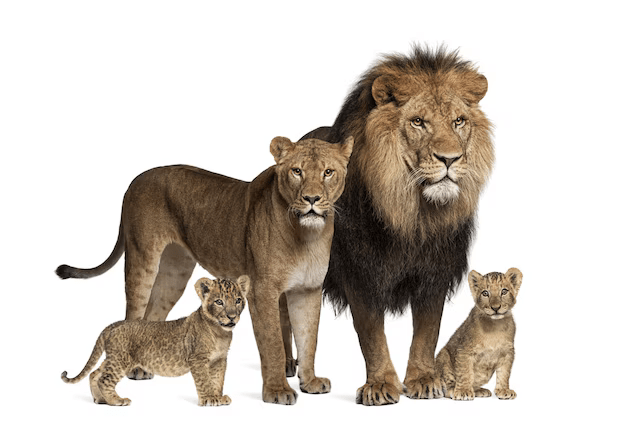
Lions belong specifically to the genus Panthera, which also includes tigers, leopards, and jaguars. Using a comparison from my early training and a wildlife education resource, I simplify these classifications for visitors who want to understand taxonomy without scientific overload. Despite their differences in size and appearance from domestic cats, lions still share skeletal structure, dental patterns, and hunting instincts that highlight their shared ancestry.
I have handled injured lions recovering from fractured limbs or dehydration, spending hours observing them. What stood out was how their grooming and responses to touch mirror those of smaller cats. While not identical, these instincts reveal a shared blueprint that nature has developed in various directions over millions of years.
Why Lions Look So Different From House Cats
The size difference alone often confuses people more than anything else. A typical lion in our care weighs around 180 to 220 kilograms, while a domestic cat rarely weighs more than 5 kilograms, so visually they feel like entirely different categories of animals. I have seen visitors physically step back when they realize just how massive a male lion’s head is compared to what they imagined from documentaries.
Behavior also plays a role in this perception gap. Lions live in social groups called prides, while most small cats are solitary hunters, which creates a psychological distance in how people relate to them. In one case last spring, I was explaining feeding routines to a family, and they were shocked that lions can coordinate hunts together, something house cats would never attempt.
Even with these differences, I often remind people that evolution does not erase family ties; it reshapes them. The lion’s roar, for example, is just a modified form of vocal communication that evolved for long-distance signaling across open savannahs. I have stood near a roaring lion during feeding time, and the sound carries a physical weight that you feel in your chest more than your ears.
Shared Traits I Notice When Working With Both Big and Small Cats
One of the most interesting parts of my job is switching between caring for rescued lions and the smaller cats brought in from local villages. Despite the obvious size gap, their reactions to stress, food, and human presence follow surprisingly similar patterns. I have seen a frightened lion pace in circles, just as a stray cat does when unsure of its surroundings.
Both types of cats rely more on instinct than on learning from humans. A lion that spent years in captivity still reacted to sudden movement with the same alert posture I see in house cats when surprised. These shared behaviors highlight their connection. Coming habits always catch my attention during daily care routines. Whether observing a lion after feeding or a rescued kitten cleaning itself, this repetitive cleaning serves the same biological purpose. Even play behaviors in young lions mirror kitten play fighting, just on a larger scale.
How Classification Helps Me Explain Lions to Visitors
When people visit the facility, I usually avoid overwhelming them with scientific terms right away because it tends to disconnect them from the experience. Instead, I build the explanation around what they already know, like their pet cats at home. This approach helps them understand that the lion is not an outsider in the cat world, but a large, specialized branch of the same family tree.
I have guided dozens of school groups, and I notice that children grasp the concept faster than adults do. They accept that size differences do not always indicate separate origins, especially after seeing similarities in eye structure, whiskers, and movement. One group later compared drawings of house cats and lions, pointing out shared features with surprising accuracy.
Over time, I have learned that classification is not just about naming animals correctly but about helping people see relationships they might otherwise miss. Lions are a clear example of how nature can stretch a single family into many forms without breaking the core connection. Once visitors understand that, their perception of wild cats changes noticeably.
Working closely with lions has made me respect how consistent nature is. Watching a lion rest after feeding reminds me that its lineage is deeply tied to the small cats seen every day. The scale may change, but the foundation remains shared across the entire cat family.