Where NaturVet Digestive Enzymes for Cats Fits in Feline Digestive Support
I’ve been practicing small-animal medicine for over a decade, most of that time in a busy Texas clinic where digestive complaints are an everyday part of the caseload. Vomiting, soft stools, foul-smelling litter boxes, picky appetites that seem to come and go—these are the issues cat owners bring up at annual exams and emergency visits alike. NaturVet Digestive Enzymes for Cats is one of the supplements I’m asked about most often, usually after an owner has tried diet changes without much success.
I don’t recommend supplements casually. I’ve also advised plenty of clients not to use them when the problem clearly required diagnostics. My perspective on digestive enzymes, and NaturVet’s product specifically, comes from seeing how it plays out in real homes, with real cats, over months—not from theory or marketing claims.
Why cat digestion actually struggles in the real world
Healthy cats produce digestive enzymes on their own. In an ideal situation, they wouldn’t need help. But in practice, many of the cats I see aren’t ideal textbook cases.
A few patterns keep popping up. Older cats often lose digestive efficiency long before bloodwork looks abnormal. Cats that bounced between low-quality foods earlier in life tend to develop sensitive GI tracts. And cats with chronic stress—multi-cat households are a common culprit—frequently present with digestive signs that don’t neatly fit a disease label.
I remember a middle-aged domestic shorthair whose owner described the stool as “never quite normal.” Not diarrhea, not constipation—just soft enough to smear. We ruled out parasites, tried a novel protein diet, and even did a short medication trial. The cat improved slightly but never stabilized. That’s one of the cases where I suggested adding a digestive enzyme supplement rather than escalating to more invasive testing. Within a few weeks, the litter box told the story before the owner did.
That’s the niche digestive enzymes can fill: not curing disease, but supporting digestion when the system is underperforming.
How NaturVet Digestive Enzymes fits into that picture
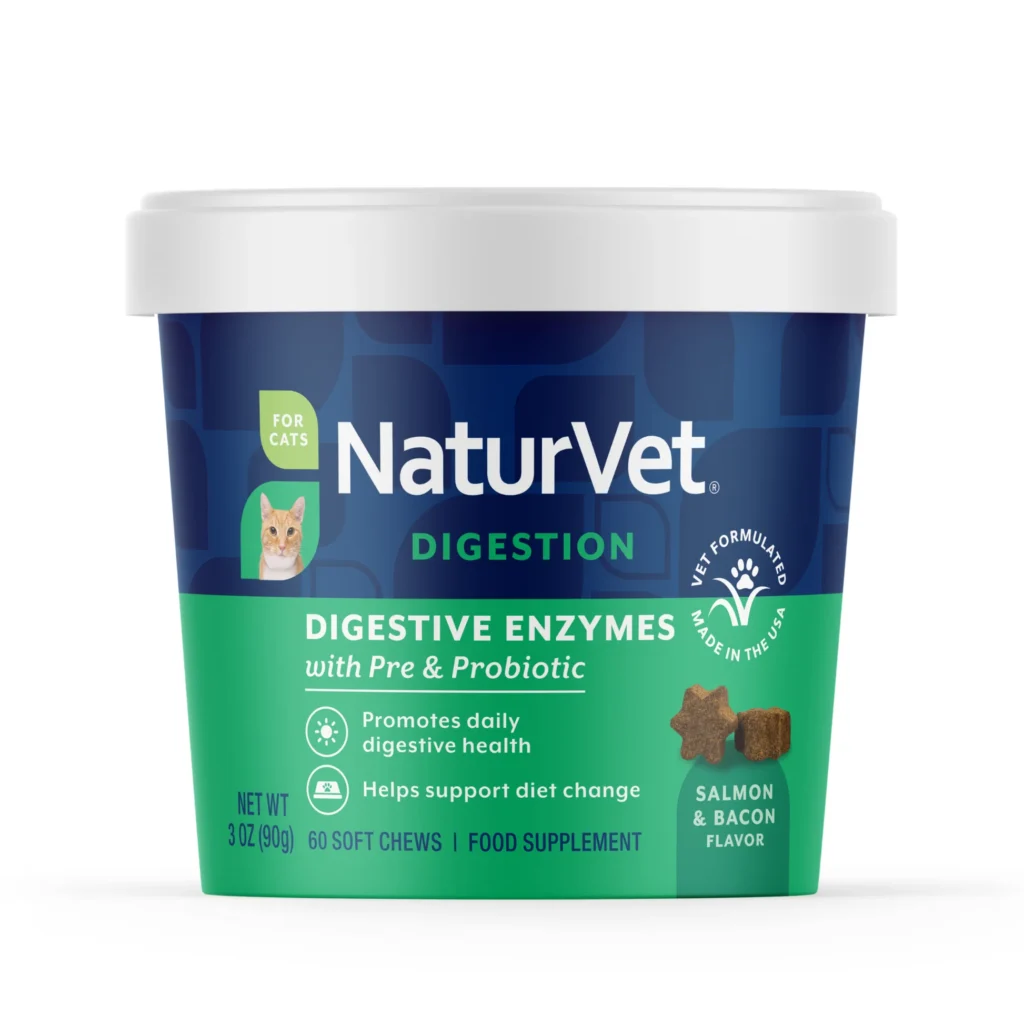
NaturVet’s digestive enzymes for cats combine plant-based enzymes—amylase, protease, lipase, and cellulase—with probiotics in some formulations. From a clinical standpoint, the enzyme blend targets macronutrients that cats actually struggle to break down efficiently when digestion is compromised.
I’ve found NaturVet’s product to be pretty consistent batch to batch, which matters more than most owners realize. Supplements vary widely in quality, and I’ve seen cats relapse simply because a new bottle didn’t perform as well as the last one. NaturVet isn’t pharmaceutical-grade, but it’s not a fly-by-night brand either.
One detail only experience teaches you: the powder’s palatability matters more than the label claims. Cats are unforgiving. NaturVet’s enzyme powder has a mild smell and blends reasonably well into wet food, which is why I tend to suggest it over stronger-smelling alternatives. I’ve watched owners spend money on supplements that worked physiologically but failed behaviorally because the cat refused to eat.
When I’ve seen it help—and when I haven’t
The cats that benefit most fall into a few categories.
Senior cats with a gradual digestive slowdown often show clearer stool quality and less vomiting. I recall a 13-year-old cat whose owner assumed hairballs were the problem because the cat vomited weekly. Once enzymes were added, vomiting occurred only once every few months, without any other changes.
Cats transitioning to higher-protein or raw-adjacent diets sometimes struggle initially. Enzymes can ease that adjustment. I’ve used NaturVet in those cases as a temporary support rather than a permanent crutch.
Then there are cats with idiopathic GI sensitivity—the ones who test “normal” but never seem comfortable. Enzymes don’t fix the underlying sensitivity, but they can reduce daily irritation enough to improve quality of life.
On the other hand, I’ve also seen enzymes do very little. Cats with inflammatory bowel disease, exocrine pancreatic insufficiency, or untreated hyperthyroidism need targeted medical management. In those cases, digestive enzymes alone are like putting better tires on a car with engine trouble. I’m very direct with owners about that.
Common mistakes I see owners make
The biggest mistake is using enzymes as a substitute for diagnostics. I’ve had clients tell me they started NaturVet because a friend recommended it, while their cat was losing weight and vomiting bile. Supplements shouldn’t delay proper testing.
Another frequent issue is inconsistent use. Enzymes don’t work like a pill you give once a week. They need to be fed regularly. I’ve had owners declare a supplement “didn’t work,” only to admit they used it sporadically when symptoms flared.
Overdosing is less common but still happens. More isn’t better. Too much enzyme powder can actually worsen stool quality, especially in smaller cats. I usually advise starting lower than the label suggests and adjusting slowly based on litter box feedback.
Practical considerations from real households
If a cat eats only dry food, enzymes are more challenging to use effectively. They mix best with moist food, and sprinkling them over kibble often leads to uneven dosing. In dry-food-only households, I usually encourage at least a partial switch to wet food before adding enzymes.
Multi-cat homes introduce another wrinkle. Owners sometimes can’t guarantee which cat eats the treated food. I’ve seen enzymes blamed unfairly when the wrong cat was actually consuming them.
Storage matters too. I’ve seen enzyme powders lose effectiveness after sitting open near heat or moisture. Keeping the container sealed and away from the litter box area sounds obvious, but you’d be surprised how often that’s overlooked.
My professional stance on NaturVet digestive enzymes
I do recommend NaturVet Digestive Enzymes for cats in specific situations. I don’t present them as a cure, and I don’t suggest indefinite use without reassessment. But as a supportive tool, they’ve earned a place on my recommendations list.
If I had to summarize my experience honestly, they’re most useful for mild, chronic digestive inefficiencies where medical workups haven’t revealed a clear disease. They’re least helpful for cats with significant underlying pathology or owners hoping for a quick fix without addressing diet and stress.
What I appreciate most is that, when they work, the improvement is tangible and observable at home. Better stool, less vomiting, more consistent appetite—these are changes owners notice without me having to point them out.
That kind of feedback, repeated over years of practice, carries more weight for me than any supplement label ever could.