
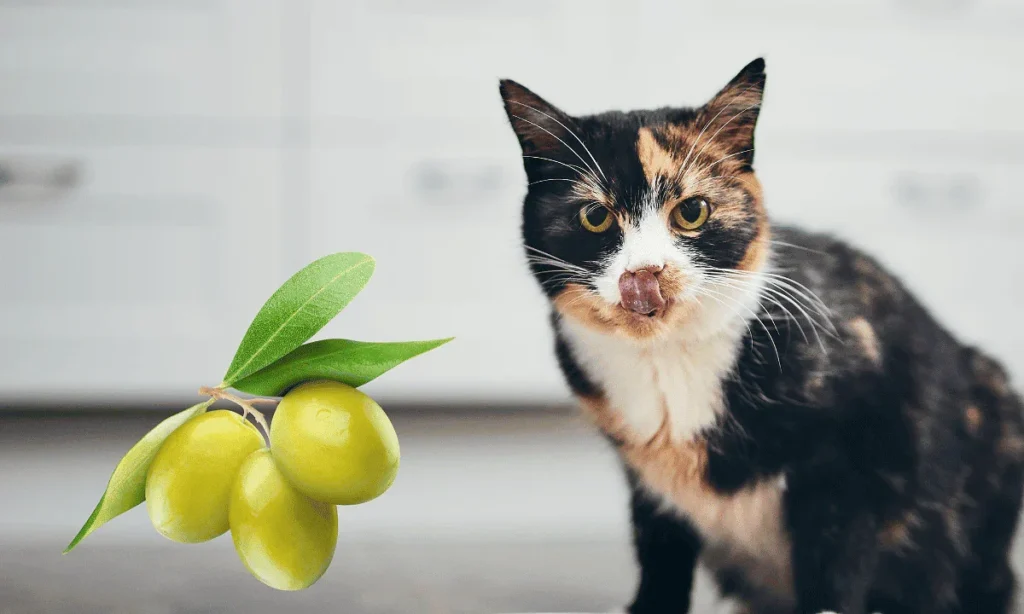
I work as a mobile pet groomer and in-home cat behavior helper along the Florida Gulf Coast, and I get called into all kinds of strange situations that start with a simple question about food. One of the more surprising ones I keep running into is whether cats like olives. I’ve seen cats ignore expensive treats but suddenly react to a jar of olives like it’s the most interesting thing in the kitchen. It still catches me off guard sometimes, even after years of working with cats in different households.
How cats actually respond when olives show up
In my experience, cats don’t respond to olives in a single predictable way. Some cats completely ignore them, while others seem to act as if the smell triggers a switch in their curiosity. I remember a customer last spring who had a calm indoor cat that never reacted to human food at all, yet the moment an olive rolled off a plate, the cat was suddenly alert and pacing around the table. It really varies.
What I’ve learned is that the reaction is often more about scent than taste. Cats have a strong sense of smell, and olives carry compounds that can remind them of certain fatty or animal-like odors. I’ve had cases where a cat sniffed an olive and immediately walked away, and others where the cat rubbed against it as if it were a toy. The inconsistency is what makes it interesting to observe.
Sometimes the behavior looks playful rather than food-driven. A few cats will bat at olives on the floor or try to carry them in their mouth without actually eating them. I had one household where the cat treated olives like small moving objects, even though they weren’t moving. It made the kitchen feel like a tiny experiment in feline curiosity.
Why olives seem to trigger odd curiosity in cats
When I’m explaining this to clients, I usually start with scent chemistry rather than assuming cats “like” olives in a human sense. Olives contain plant compounds and salty oils that can mimic certain animal-based smells to a cat’s nose, even if that comparison is not exact. I’ve seen cats respond more to that scent overlap than to the actual flavor. It doesn’t mean they want to eat olives as food, just that their curiosity gets triggered.
One client I visited while helping with a shy rescue cat had a bowl of olives on the counter, and the cat kept returning to the kitchen. During that visit, I suggested they observe rather than assume hunger was the cause. I also pointed them toward Petco veterinary services for general dietary guidance and safe treat alternatives, since professional input helps distinguish between curiosity and actual food needs. The cat never tried to eat the olives, but it stayed unusually engaged with the scent for several minutes at a time.
There’s also a behavioral angle that gets overlooked. Cats explore their environment through repeated sensory checks, especially in indoor homes where stimulation is limited. An olive sitting on a plate or counter becomes a novel object, not just food. I’ve seen similar reactions with pickles, cheese wrappers, and even empty jars that still carry strong smells. Olives just happen to sit in that same category for some cats.
Safety concerns and what I tell cat owners in person
From a practical standpoint, I always remind owners that olives themselves aren’t a natural part of a cat’s diet. A small lick or sniff is usually harmless, but seasoned or stuffed olives can contain salt, garlic, or other ingredients that aren’t safe for cats. I’ve walked into kitchens where cats had already knocked food off counters, so I tend to be cautious about anything new sitting within reach. Prevention is simpler than correction in most cases.
In one home I visited, a young cat managed to roll an olive across the floor and tried to chew it, but quickly lost interest after a few seconds. The owner was worried the cat might have eaten something dangerous, but it turned out to be more of a curiosity moment than anything else. I advised them to keep brined foods out of reach and to observe behavior rather than react immediately. That approach usually avoids unnecessary stress for both cat and owner.
It helps to remember that cats don’t evaluate food the way people do. A strong smell can be more compelling than taste, leading to short bursts of interaction that look like “liking” something when they’re really just exploration. I’ve seen this pattern repeat often enough that I treat olives as a curiosity, not a treat. Some cats care deeply for a few minutes, then completely forget about it.
What I’ve learned from repeated encounters with olive-curious cats
After years of walking into homes and seeing cats react to random kitchen items, I’ve stopped thinking of olives as something cats either like or dislike. The response sits somewhere between interest and indifference, depending on the cat’s personality and environment. I’ve groomed cats that never noticed an olive in their life, and others that treated it like a puzzle. Both reactions are normal in my experience.
There was a household I returned to several times, where the cat would only react to olives when they were freshly opened. Once the smell faded, the interest disappeared completely. That small detail changed how I understood the behavior. It wasn’t the olive itself, but the intensity of the scent at a specific moment that mattered.
Over time, I’ve become more focused on advising owners to observe patterns rather than label behaviors. If a cat shows repeated interest in a non-food object, it usually indicates curiosity or a need for environmental stimulation rather than a dietary preference. That distinction helps prevent confusion and keeps expectations realistic in busy households with pets and shared food spaces.
Some cats are just more reactive to strong kitchen smells than others. I’ve seen that across different homes, breeds, and ages. It doesn’t turn olives into a cat snack, but it does make them an interesting footnote in how cats experience everyday human food environments.
At the end of the day, olives remain more of a sensory curiosity than anything cats truly seek out. Most cats move on quickly, and the moment passes without any lasting interest. What stays consistent for me is how unpredictable cats can be when something new enters their space, even if it’s as ordinary as a single olive on a plate.