
As a mobile cat groomer, I work with a wide range of feline personalities, from calm lap cats to anxious rescues. One behavior that always stands out is how many cats keep their tails moving even while asleep. Initially, I thought it was random twitching, but years of observation revealed patterns. This subtle habit actually offers insight into a cat’s inner state.
Light sleep and dream activity in cats
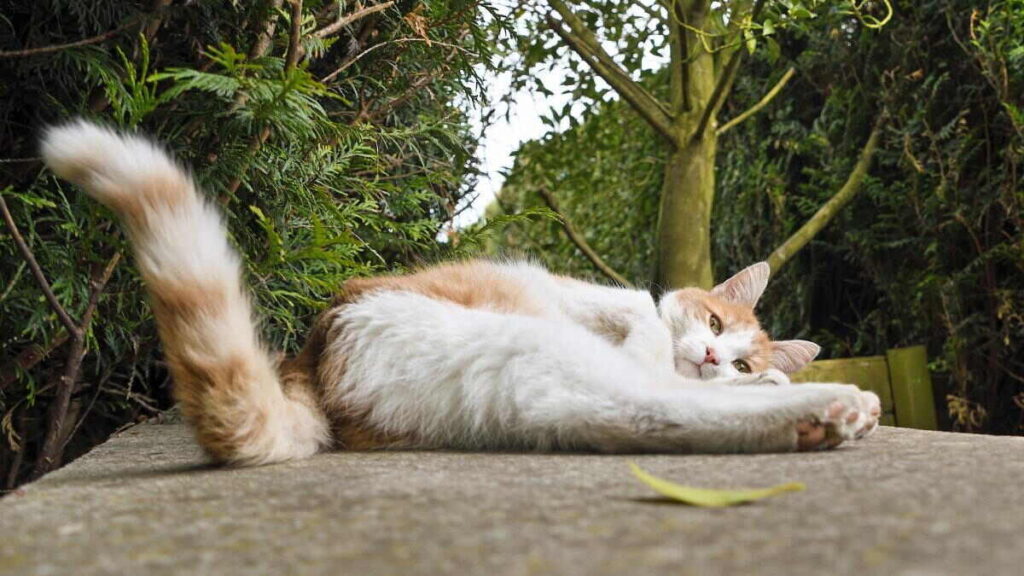
Most of the tail movement I see happens during light sleep or what owners often describe as “half-asleep mode.” Cats do not sleep in a single block the way humans expect; they cycle through stages in which their brains are partly active. During these phases, the tail can flick, twitch, or even tap against the floor while the rest of the body stays still. I remember a customer last spring whose orange tabby would curl up on the couch and keep its tail moving like a metronome, even while the rest of the cat looked completely knocked out.
In my experience, this is closely tied to dreaming. Cats process a lot of sensory information during the day, especially movement, hunting instincts, and territory awareness. Their brains replay bits of that activity while sleeping, and the tail often reacts as if it is still part of that world. I have seen cats flick their tails faster when they seem to be in deeper sleep cycles, almost as if they are reacting to something in a dream sequence.
When I talk to pet owners about sleep behavior, I usually suggest observing the tail alongside breathing patterns. A slow, steady breath with occasional tail twitching is usually normal REM-like activity. A more rigid body with sharper tail flicks can sometimes indicate that the cat is only partially asleep. That difference is subtle, but it becomes easier to read the more time you spend around them.
Communication signals are still active while resting.
Many people assume that sleep means all communication stops, but cats do not completely shut down their body language. Even while resting, they keep certain signals active, and the tail is one of their most expressive tools. I once worked with a shy rescue cat who would sleep near me during grooming sessions but still twitch its tail whenever I shifted my position too quickly, as if it were keeping track of everything, even in sleep.
For owners trying to understand these subtle signals, I sometimes point them toward helpful behavior resources and real-world guidance, like a cat sleep behavior resource that explains general feline sleep patterns in a way that matches what I see in daily handling work. It is useful because it helps connect what people observe at home with what is considered normal cat behavior in controlled environments. I often remind people that even a sleeping cat is still somewhat aware of its surroundings through sound, vibration, and scent.
The tail acts like a leftover communication line that never fully disconnects. A slow swish can mean mild irritation even at rest, while a quick flick might indicate a reaction to nearby noise or movement. I have seen cats sleeping through loud conversations but still responding with tail movements when a door closes or a dog walks past the room. It is subtle, but it shows how alert their nervous system remains even in sleep states.
Stress, comfort, and emotional processing
Another reason I often see tail movement during sleep is emotional processing. Cats carry stress differently than dogs or humans, and they tend to release that tension in small bursts rather than obvious reactions. In my grooming van, I have handled cats that appear calm on the surface but still show tail activity after they finally settle down. It is like their body is catching up on emotional sorting once they feel safe enough to rest.
One common situation I notice is after a long travel or a vet visit. A cat may fall asleep quickly at home, but the tail continues to move in short, uneven flicks. This usually settles after a few sleep cycles, once the cat fully decompresses. I have seen this pattern repeat so many times that I now consider tail movement a useful indicator of how recently a cat has been through a stressful experience.
Comfort also plays a role. A cat that feels completely safe often has slower, more relaxed tail motion during sleep, almost like a gentle rhythm. On the other hand, a cat in an unfamiliar environment might show more irregular movement. It is not always easy for owners to interpret, but watching the consistency of tail motion over time gives a better sense of emotional balance than a single moment ever could.
Instincts that never fully shut off
Even in deep rest, cats never fully turn off their survival instincts. I have seen indoor cats react in their sleep as if they are still tracking invisible movement, especially if they live in homes with outdoor noise or other pets. The tail often acts as the first physical response before the cat even wakes up fully. This response is quick and automatic. It is deeply tied to instinct rather than conscious thought.
There was a household I visited regularly where a pair of cats would sleep near a window overlooking a busy street. Even during naps, their tails would flick whenever a car passed or a bird landed outside. They were not waking up, but their bodies were still processing environmental changes in real time. That kind of sensitivity is something I see more often in indoor cats who remain alert to outside activity.
These instincts are part of what makes cats such efficient hunters in the wild, even if most domestic cats never need to hunt. The tail movement during sleep is just a small echo of those ancient survival systems still running in the background. It is not something they consciously control, and in most cases, it is completely normal behavior that reflects how finely tuned their senses are.
After years of working closely with cats in different environments, I have learned that tail movement during sleep is rarely the result of a single cause. It can be dreams, communication, stress processing, or instinct, all working together at once. What matters most is the overall pattern, not the movement itself in isolation. Watching how a cat behaves across different sleep moments often tells more than any single twitch ever could.